Friday, 18 December 2015

Winding down the Blog

There have been some long gaps between posts and that is usually a sign that I've started to run out of ideas.  Now that two growing seasons have more or less been had, there is only going to be more repetition.  A different pest, a different gaffe in marketing, but I feel like I know at this point what our farm is about and the general direction it is going (as outlined in the blog to this point).

The idea was that I was going from being an urban kid, whose contact with rural life was limited to an annual day trip to an aunt and uncle's farm and the odd whimsical stop on a trip to another city, to a country dweller.  Well, it would be a stretch to say that I have become a rural person to the core and that the city with its bright lights, freeways, and long list of cultural events in the alternative newspaper's listings is overwhelming to me now.  But I have come to live a mostly rural life.  I spend an evening a week in the city doing errands and maybe staying at the library for a few hours (we still do not have high speed internet access at home).  But most days are on the farm or at my part-time job, which is also rural, agricultural, physical.

We have a couple of sheep now, along with a doe and a buck, who are together with the intent of the doe being bred.  But they are buddies more than awkward breeding companions.  We have a pig and a bunch of chickens that are still laying even as we approach the shortest day of the year.  We have a couple of geese and a drake, they are an odd crew, wandering together, the geese tearing into the grass, which is still sort of growing, the drake digging under it, looking for something with a bit more meat.  It has been an easy start to winter, after two really long and harsh ones.


We began this life thrown into a winter of major snow storms and a long ice mess - challenging circumstances when you have animals in a barn a couple hundred feet from the house.  We have good pictures from that time.  Carrying feed pails as the dog walks alongside, deep snow.

The start was hard - there was a lot of money going out and hobby wages coming in.  There was a lot of shovelling and digging, the effects of which were satisfying, while the effects on my body will probably present in the coming years, unpleasant surprises in my joints and gait.

I've settled into the reality of local food.  I have gone from being wide-eyed, to being outraged at how little seems to be seized in the revolution we are supposed to be having, to being more aware but also more tempered in my frustrations.

I recently attended a lecture entitled "Urban Food Revolution."  It was about the myriad successes of rooftops, hydroponics, SPIN, food hubs, and about the unfortunate realities of food miles, food deserts, food waste.  It was an array of issues I've learned all about.  It was not new, though it would be to some people.

I made myself give the presenter credit for the fact that his portrayal of local food was mostly valid.  It is bound to be a slow, spotty shift to people being more involved in their food and caring more about how it is grown and shipped.  But I would want to add to the discussion that in spite of the many interesting things happening (apparently Telus and Sheraton are mandating that their towers have rooftop gardens - I think I have that right) much of it is cosmetic.  They mostly just feel good.  And look good.  They ruffle few feathers and break few budgets.  Granted, they do provide some meals and maybe even contribute to the needy who still mostly have to rely on processed foods like canned beans and sugar cereals.  The true value of a small sunned space and some soil is hard to appreciate in the world we live in.

Most of the small businesses I know around local food are struggling to make a living, trying everything they can think of - a new farmers market, a storefront, a great new product that no one else has thought of, and it's an uphill battle.

But we are at an alright place:  we now have a year-round weekly market that is working reasonably well for us and giving us a base income to build upon.  We have hosted a few very fun cooking classes and had a good go of growing winter greens in the unheated greenhouse, which has made us more confident that we can maintain a good variety of nutritious foods throughout the year.

Keep abreast of developments on Long Road Eco Farm's Facebook.

Friday, 9 October 2015

The Election Sign

The past few days have been windy and candidate signs are being blown down.  Given our location (we are right on a busy highway at the entry point of the township) we have the opportunity to catch the attention of many if not most of the township's population.

In rural communities - sometimes well off the beaten path - you find houses with hand-painted signs posted on front lawns.  This past summer I passed a house on a back road covered with such signs, all deploring the Ontario sex ed curriculum....a patchworked lament about how it is destroying a generation, etc.

Our sign is simple:


I'm sure many would agree that this has been a nauseating election race, with a few bright spots - there have been many clear-headed insights and stances amidst the sleazy tactics, such as the many voices reminding the voting public that there are more pressing issues than the niqab's place in citizenship ceremonies.

There are, of course, plenty of issues that are being largely ignored.  Health care policies, aboriginal issues and food.

There was a candidate's meeting in Kingston last week on the issue of food security, and it was my chance to see what those running in my riding were like.  In rural ridings like mine, the candidates are not always suave.  One was a bit wooden in his delivery, and mostly reverted to platitudes, one read directly from the party manual in a monotone, one was more seasoned and charismatic, and fairly articulate, one didn't show up (I'm sure I don't need to say which party was the no-show).  The riding will most likely go to the latter candidate.

After the opening remarks and a couple of questions, I had to get up and stretch.  I stepped out of the room, and then stood in the back when I came in.  I wandered over to the banquet tables, where coffee and muffins were set out, and got a drink.  I gazed around the room, picking out the candidates' handlers, mostly in suits (mostly sharper looking than the candidates themselves).

It seemed that the questions all bled together and the responses suggested that there were no bright ideas on how to get more out of our own country's capacity to grow good food and make it available to more people.

This makes people like me second guess my hope for a better food system.  No matter what evidence there is to suggest that big changes in agriculture are necessary to environmental sustainability and the welfare to farmers (consider the idea that currently, crop farmers work off-farm to make up for the losses in their farming venture - essentially subsidizing the large seed and pesticide companies they buy from regardless of their own profitability) no politician with serious prospects of being elected would support anything much outside of the status quo.

These issues well up over time as they are neglected.  Health care becomes less sustainable and slowly sinks into crisis as the population ages.  Aboriginal communities become more alienated from government and less able to trust them.  Food eventually becomes inedible in spite of its abundance.  Farming, already unsustainable for the farmer, becomes phased out as new generations are less willing to swallow the bitter reality of working two jobs for the income of one.  This is where I am reminded of the fact that, although Canadian politics still rolls its eyes at my farm and calls what I do a quaint hobby, its general tenets are really the inevitable direction of food production (small-scale, local and not reliant on large, powerful, litigious companies patenting seed) and something that will continue to take hold and evolve as politicians strategize over their latest niquab issue.

Saturday, 12 September 2015

Squash Harvest

Although today, as I write, it's been raining steadily (it's the first rainy day we have had since the spring I think - though we have had an almost ideal rainfall this year - often overnight or short bursts during the day) yesterday I spent most of the day harvesting squash, weeding the struggling strawberry rows, and setting up beds for greens that will go into the fall and serve the first part of winter CSA shares (before winter sets in and we will use hardy vegetables grown in the greenhouse).  It was a beautiful fall-weather day.  The sun seemed less intense and not as high for as long as I've been used to, and the air was a bit drier andcrisper.  The trees in the forest are still fully green and in their shade it could just as well be spring.

The last couple of weeks of August were hot and humid, and work had become so repetitive and unsatisfying that I got frustrated and morose, even thinking about getting as far away from farming as I could and soon.  The shift in the weather, and seeing the squash patch cleared - and a good abundance in the shed where they'll be left to cure, has shifted something in my mood and outlook.


I welcome fall and winter. Life goes more at a pace that suits me - the hard work of farming is generally satisfying, and one of the things that drew me to it, now that I think about it, is the idea that the pace of life is slower.  (That's not the case in the summer, when we are scrambling to make as much in sales as is possible to offset a slower winter season).  There is no way around the fact that the modern world demands a constant speeding up of life's pace.  The man credited with developing the cell phone was recently on CBC lauding his invention for how it improved productivity and allowed more people to do more things at once.  But it's probably more a mixed blessing.

I have noticed that most of the time since I've been farming, I've felt that this is the pace that is compatible with my own physical and mental functioning.  Life in Calgary in 2005, and life in Toronto in 2012 were both a constant, blurred rush.  I caught a lot of colds, and felt more often than not that I was in a sort of soldiering-on mode.  If there were ways to live a more mellowed life, I couldn't see it.  It's a tall order in 2015, and I think it's something many of us are seeking at the core.

Friday, 14 August 2015

The P Word

Thinking back on the evening, it was like a strange dream.  We were set up at the market, ready to go, when the power failed.  The band cut out and the vendors running cooking devices all looked back to some unspecified spot where power happens, or around for some unspecified person who could make power happen again.

Then, like little ants scurrying, we unplugged cords, tried other outlets, reconfigured our various plug-in arrangements, and slowly, power came back on...first the band came through the speakers and got back into their set.  Then the Indian food vendor went back to frying samosas.  Somehow we were still without power.  We rallied the organizers to find a reliable outlet for us.  There was one strangely set into a tree, about two metres up from the ground.  The cord wouldn't reach.  Then there was another atop a lamppost (again, it was like a strange dream) and that one was out of order, we realized, after climbing a ladder to plug it in.

All the while the band played on, the crock pots a few booths down simmered on, the smell of frying permeated the square.  And yet, there it sat, the little griddle seeking a current.  Throughout the ordeal, we kept telling people they could still take their food home and heat it up themselves, but it was a lost cause.

With an hour left in the market, we shrugged and started slowly stacking our boxes, sitting there. The consensus among our fellow vendors seemed to be that it had been a stellar day.

Driving home, we couldn't help acknowledging that there is something pathetic about the whole business of being market vendors for a living.  Pathetic might be a strong word for some.  Most vendors downplay poor showings at market, saying, "there are good days and bad days," or, "well, had a few new customers so it's all good."  Most jobs have petty sides, boring sides.  Plenty of good, reputable, well-paid jobs have a shady side.

Being in the local food business gives us a certain street cred - when you tell people you have an ecological farm, it sounds wonderful.  But I suspect that when they catch you in the moment of scrambling with the extention cord, flustered, bordering on desperate, the glow dims a bit.


Monday, 20 July 2015

A Third Trip for the Fat


We have learned the hard way that slaughterhouses are places not only of killing, but also of a more mundane kind of shady business. We had been going to a local abbatoir for our pigs until we realized, on our last visit, that they had shorted us by about two dozen pounds of meat – meat that would be sold for $11/lb. It was not a negligeable amount. Though, which cuts were missing, we had no way of knowing for sure. The fat was particularly low, though.

I use fat to make lard for pastry – it is of significantly better quality than Tenderflake, the standard store-shelf lard, which is heavily processed and hardly digestible. Good lard is hard to find – few farmers who keep their own lard have enough to sell, and I don't know where the rest of it goes, but abbatoirs don't seem to have a lot on hand.

We went to another abbatoir further away this last time – in fact, a good hour away, hoping that we would have better luck. Sure enough, upon returning from our second long trip to pick up the meat we had delivered a week previous, we realized the fat we had requested had been left out altgother.

We made the third trip this week.

Since we began farming, we have had no expectation of taking summer vacations, but this was an opportunity to make use of a business trip to enjoy a few hours of leisure before heading back to do afternoon feeding, weeding, strawberry picking, watering, steamed bun making, wood stacking, goat herding, garlic scape picking, and supper.

What a day it was: we got to the abbatoir minutes before they were to close for lunch, picked up the bag of white mass, stuck it in the cooler, and drove back towards the tourist towns of the county, stopping along the highway at a couple of farmgates – little tables set up in some places, others elaborate structures, some stores with proper cash registers.

We took note of the way people interacted, the displays, and the food itself. Generally, there was nothing memorable – cherries, raspberries, a feta and spinach pastry with a waffled surface, a loaf of bread – but it was certainly more satisfying than what we usually accept as road food.

As we were driving on the 401 earlier in the day, I had noticed Denny's after Denny's,  McDonald's after McDonald's, Tim Hortonses everywhere...and asked XB, “isn't it strange that these few companies, owned by a tiny proportion of the population, people who live far away and have never been to Napanee or Picton, are everywhere, absolutely everywhere except for dying towns like ours?”

We headed south at the County's main town, wound along nice two-lane highways, and after a few turns and twenty minutes, arrived at the winery owned by people who vend at one of the farmers market we do.

We were served samples of five wines, and two cheeses, and I, for the first time, noticed interesting flavours and characters in wine.

The little detours brought out an enjoyment that is hard to come by when you have more time and money than you need. There was no time for the squabbles and boredom that happen on extended vacations, nor was there enough spending opportunity on the few stops we made, to feel like money was pouring out.

We bought a bottle of wine and a block of cheese and drove back through the main town, across the lake, and stopped on the native reserve just outside of Deseronto, at a tiny cafe.

We ordered a coffee and a smoothie, browsed some of the native crafts, the bear cream, the wall of aboriginal artists' CDs. The owner invited us to stop out back and see the yard where summer concerts are held, and have a seat in the teepee, drink our drinks in there if we wanted. We sat down, it was comfortable, cooler and nicely shaded.


After a few more minutes by the water, seeing people waterskiing, hearing the buzz of motoboats, and breifly revisiting the Canadian dream, we got back in the car and drove back to the farm.    

Monday, 8 June 2015

Sunday Morning

We have not been late for market yet this year.  Each Sunday, we are up at just the right hour so that, if we work at a frenzied pace, using every minute efficiently, we will be on the highway in time to arrive at the market for 8:30 without having to speed to get there.

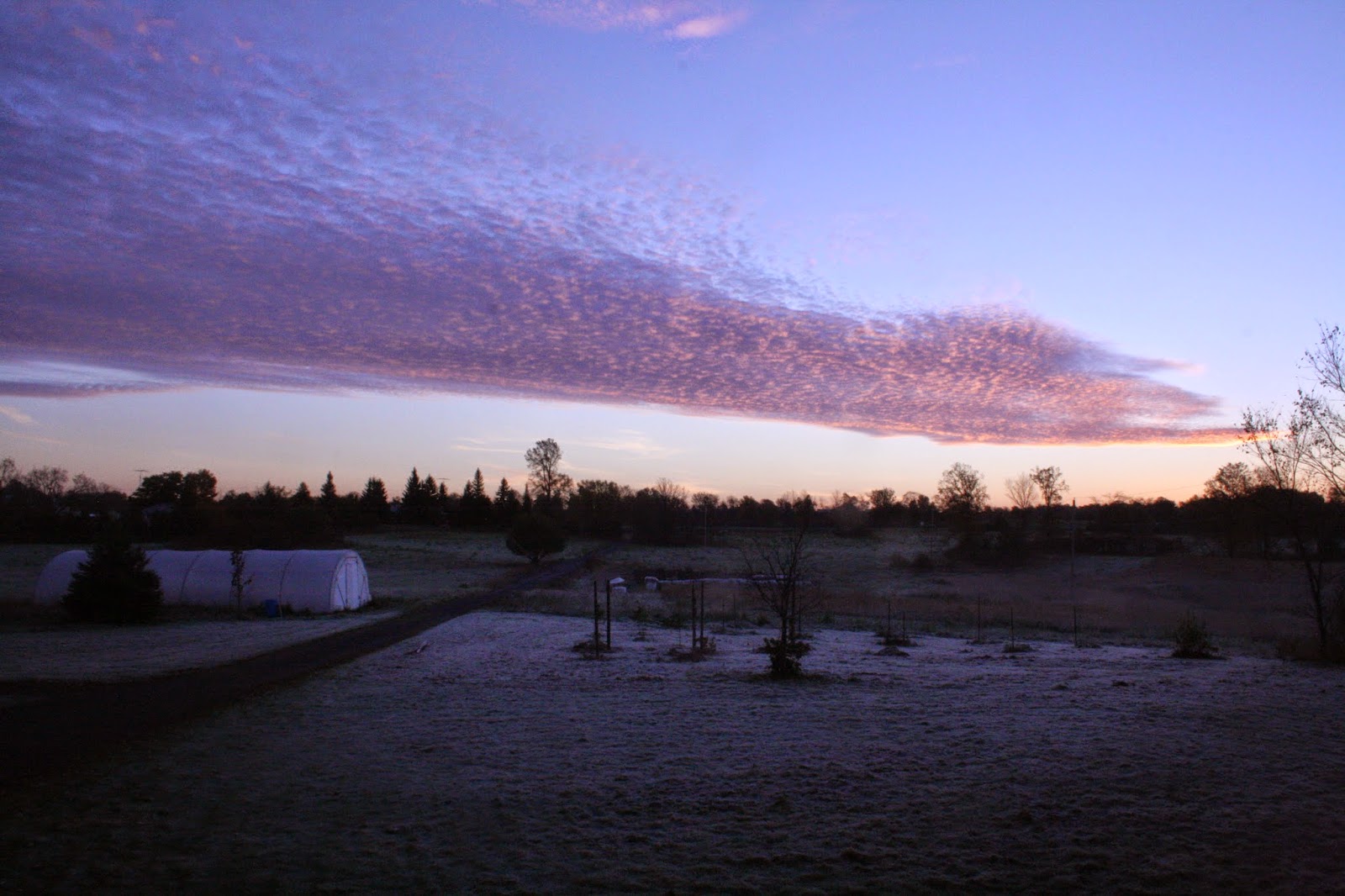
This past Sunday, I had to take a quick break from rolling pastry dough to take this picture:


As we pulled up to the market later that morning, we saw an interesting sight.


A 50-foot (maybe it;s 48 -foot) flatbed tractor trailer had parked overnight in the centre of the market square (or the section of parking lot that acts as the market square). Apparently the driver had sought permission from the police to park there.  As far as anyone knew, there would be nothing going on the next day.  I have driven my car with a u-haul trailer attached, for hauling supplies or pigs.  The first time I rented one, I found it impossible to back into a space without the trailer going the wrong way.  It took be about three rentals before I managed to figure it out.

This driver made it look easy, but I have seen truck drivers trying to back into narrow laneways in downtown Toronto and having trouble, and at one point I had a kitchen job doing deliveries, and at the end of my rounds I would have to back the van into a parking space off a busy road, with impatient traffic. It kept me awake at night.

We had actually assumed, when we first saw it parked there that it was part of a special event.  It wasn't until the market manager commented as she passed by with a cartload of tables and chairs, "there's always something interesting,"  that I sensed it was an unwelcome surprise.  But it was good, it gave people something funny and unusual to talk about.


Friday, 22 May 2015

Greens are doing well


The greenhouse has a lush green floor.  There is bok choy and garland chrysanthemum, cilantro, spinach and now a very tidy lettuce patch.  We have been struggling to keep flea beetles from getting out of control, but it looks like our efforts (catching and pinching) are paying off.  They seem to be few and far between.  Fortunately, there are no other signs of pests.  Greenhouses are handy in that they give cover from wind and cold, and pests are not as keen to enter and set up shop.

Seedlings in April

We are doing a Sunday market in Kingston and have a few food box shares (a weekly pickup of vegetables, eggs, and some steamed buns).  The season is off to a fairly good start - we are back into a steady income (relatively speaking) and we have a fairly good sense of what we want to do for selling efforts.  

I can remember last year running a farmgate operation throughout the week before Friday and Saturday markets in our township.  We did get customers, but we were at a point in our farming and business career where we just wanted to get something going - and that meant winging it sometimes.  A car would drive up at some point in the day (maybe two or three over the morning and afternoon) and either we would be inside working on dim sum, or we would be in the fields doing chores.  

We would greet the guest (almost always someone we'd never met before) and tell them what we had available.  There was a table set up in the garage with the day's vegetable pickings, and a sign listing our pricing - pork, chickens, buns, egg tarts, dumplings.  I'd often have to shoo the cat away or chickens that had gathered at the garage entrance. 

It was a kind of commerce that most people aren't used to, and it has made for interesting memories, mostly fond ones.  Some days we'd be having lunch and a car would slowly roll down our laneway. Whichever of us saw it first would announce...."Customer!"

I have to admit, Sunday market works better for us than managing an all-day from-the-house selling venture.  We are working on setting up a farm stand at the foot of our laneway, close to the highway. Something rustic and professional looking and mostly unmanned.  Somehow, even though the local food movement talks about how much people like to connect with their farmers, we've found that people also seem to enjoy some distance.  Many people feel uncomfortable alone in the presence of a vendor selling something because they can't as easily walk away as they can in a grocery store.  There is nobody to offend there.  

The idea would be, if someone wants to meet us, and discuss the farm and what we produce, they would just need to drive up to the house and honk.  We are hoping to have it up for next summer.

It's important for people farming like us to find a way to juggle producing and vending with as little unnecessary stress as possible.  This means finding efficient and satisfying ways to sell, and giving up the ones that seem to take up so much time for so little return.  There are many such opportunities - you start to reason that if nothing else, you get some reading in, but after a while you just can't sit through markets where only a trickle of customers come through, or where most of the people passing through aren't there to buy, they are only there to examine this strange thing they have never seen before (a farmers market).  

But a good farmers market is satisfying.  Many small farmers complain, "who has time to sit around when you could be farming," while other insist that the farmers market is a fading concept.  But our Sunday market in Kingston seems to have some real momentum.  It is growing and attracting a good crowd, and there is an amicable feeling among the vendors because we are busy and engaged and pleased to have a place to buy or barter.

It's satisfying as well being able to bring a few bags of bok choy and salad mix and show the world that we know how to grow good vegetables.


Monday, 20 April 2015

Spring

Spring has come so suddenly - we went out to Maberly, a small town about an hour north on April 7. I had only been as far north as Godfrey before that.  To put that in perspective for anyone not from this area, it might be like living in Windsor - as far south as you get - and going up to Moosonee after only having been as far as Sudbury...something like that. It was winter that day, as we toured a farm as part of a group of farmers called CRAFT - Collaborate Regional Alliance for Farming and Training.  We looked at a farm that is 30 years into its making.  It is a beautiful project, and yet, after 30 years, there are still too many loose ends to count.

We are entering year two, and with spring having come so cheerfully last weekend, and staying up until this point with consistently nice weather, we have begun the juggling act anew.

I have digressed over the winter to reading and writing about food issues, and those issues remain at the heart of my pursuit of farming.  But the day-to-day farming is made up of projects that are less aspirational.

We moved pigs this weeks, from their space in the greenhouse to a pasture that will be a future garden space.  Pigs go off on their own when you let them out - they don't tag along.  And so we herded, bringing them so close to the doorway to the fenced yard with its fresh grass - only to see them run back into a bush a few hundred feet away.  The dog tried to herd them, and she is good at it, but they have outgrown her.  They just get panicked, and the dog just kept at them hopelessly, but no one budged.

Finally pig A was worn out from the dog's authoritarian trip, while pig B wandered in a patch of prickly ash, seeming to enjoy herself.  I shooed the dog away, seeing Pig A panting, and realized, with about twenty feet to go back to the greenhouse where they had been staying (seeing that we weren't going to get them to pasture that morning) that I would need to coax her.  I scratched her chin, and then took a step back, holding out my hand to see if the promise of more scratching would bring her to me.  She kept stepping forward for scratchings, and eventually we were back where we started.

The morning had been a lot of work for nothing, but projects often come up that have to be done twice.  Farms are unruly.

That evening we managed to move them more easily with a big bucket of grain, and they spent the rest of the evening digging.  I went out at 10:30 to check on them and they were still in a digging frenzy.  They weren't used to their surroundings, and didn't really know where to sleep, so I guess they just decided to keep digging until they dropped.

We moved the goats to the barn the next day and started tearing out the housing infrastructure of a greenhouse, where they had all overwintered.  There was straw and manure that needed mucking, and pallets joined together that had to be disassembled.  It was a dusty, stinky job - maybe the worst job I will have to do all year, but the hay and manure has been piled for compost, which is the heart of our farm project.

The UN has named 2015 the International Year of Soils.  Soils build up slowly in the natural world - it takes about 500-1,000 years to gain an inch, but it's easy enough to erode them.  Soil with high organic matter is better able to absorb water and resist erosion, which is a big part of the point of compost, which gives some motivation to tasks like mucking stalls.  As a farmer, you really have to remind yourself that the resource you are shoveling is better than gold.  


Sunday, 22 March 2015

C-51


I have been reading a lot about the new anti-terror legislation and, like many people, I've been feeling privacy's prospects for the future crumble.  It's my view, one very much borne of a typical Canadian education and socialization, that a buffer against the state is always more important than a buffer against mostly nebulous threats against which the state insists it needs to protect its citizens.  

There have been many eloquent thoughts expressed about what is happening to privacy, and there have been endless warnings about the dangers of a surveillance state, and there is not much I can add to that.  Suffice it to say that when a government like our current one tells its people that it is its role to keep them safe, I feel less safe.

Bruce Schneier points out in an interview with NPR's Democracy Now, "Privacy is not about something to hide...privacy is about individual autonomy...when we're private, we have control of our person.  When we're exposed, when we're surveilled, we're stripped of that control, we're stripped of that freedom."

What does this have to do with farming or local food?

Just as the government asks us to give something up in return for "keeping us safe,"  we are surrounded by forces that insist they are there to feed us, and they ask, tacitly, that we give something up in return.  Visit a university and hear Food Services use language like, "it's a big task feeding so many people day in and day out."  Multinational Sodexo finds time to run a "Feeding our Future" program for children in need on top of making sure students and faculty have wholesome foods in their stomachs to keep them going.  Not to say that the food served at my local university is somehow substandard, or that there is anything wrong with people choosing to buy food there, or that the campaign must have no merit because it is Sodexo that is running it.  It's the clever angle they take that is disturbing to me:  we are not there to make money, we are fulfilling a calling.  They have crafted a "where would they be without us?" message (to my knowledge, there haven't been any "bring your own lunch" campaigns on campus).

Companies like Kraft (owned by tobacco company Philip Morris in the 2000s in one of its many conglomerate incarnations) have countless campaigns around their role as Nurturer:  Feeding America Partnership...Toddler Feeding Tips...Huddle to Fight Hunger Campaign...Kraft Fight Hunger Facebook group...Healthy Living:  Smart Dinners, Desserts & More…and now Kraft Singles bears the Kids Eat Right logo of the Academy of Nutrition and Dietetics.  Bear in mind that it is not cheese, but a "pasteurized process cheese food," one whose quasi-perishable quality has fascinated many, and left many like myself to wonder how this counts as food.  

Gerber brought us the Nestle Feeding Infants and Toddlers Study, helping us understand nutritional gaps in the diets of America's children.  This is the same company that spread its message throughout the developing world beginning in the 70s:  Our formula is better than breast milk.

Coming back to C-51 and the very personal loss of privacy, something over which I have little control -  I think there are many losses happening and they surround the concept of autonomy.  When it comes to food, I have made it a central part of my life:  being involved in a small way in a local food system and taking more responsibility for knowing what I am eating, and knowing more about the consequences of how food is sourced.  While I am slowly giving up on privacy, I feel I still have a prospect of autonomy around my food choices - something equally, if not more important.

I don't want to put this forward as a sales pitch:  "You can't trust Big Food, but you can trust me - let my farm be your provider."  Instead, I hope more people will see the appeal of regaining alternatives to the way things are going - of asking "what are we quietly being stripped of?" as these forces larger than life ask us to just let them take care of us.

Wednesday, 11 February 2015

A Tale of Two Farmers Markets

Has the farmers market movement peaked? An NPR article said so on Feb 5, and another one in The Los Angeles Times reinforced this view a few days later.  As for the markets in Kingston, we instead see a tale of two farmers markets:  one on the rise and one in decline.

As we began loading up the car for last Wednesday's farmers market, we paused for a moment and asked each other, "do we really want to do this?"  It's a lot of work going to a market, and when you barely break even, it's also a strain on morale.  We are small-scale farmers who market our goods from our farm and from local stores, but farmers markets have been our best avenue for establishing a customer base and generating income. Good farmers markets, that is. There are those you look forward to attending, and those that just are not worth the bother.

What is it that makes the difference between good and bad markets?  There are people working to make small farms and local food viable again, and there are also people working successfully to keep Big Ag getting bigger.  When it comes to farmers markets - one of the main hubs for local food in the absence of the new big thing that will make local food more sustainable over the long term - there are some that grow into something solid and there are others that fall from great heights.

Here is a little tale of two markets right here in Kingston.  One is at the University, the other is at the Memorial Centre.  The latter seems to be growing, while the former has dwindled.  The farmers market at Queens was once a bustling, vibrant gathering of vendors selling everything from Indian Curry to Russian specialties to produce and home baking.  When I ask other local farmers if they were ever involved in that market, I often get a response like, "years ago.  It used to be good.  And then..."


The number of vendors has slowly dwindled to the two or three that currently attend, us included. When attendance falls, it is due to a lack of business.  But business doesn't slip just because. Something new has to come along to take customers away, or something has to be taken from the strength of the market.  

When, several years ago, market vendors were no longer allowed to sell hot food, the central attraction was gone.  You could still sell frozen and refrigerated items, but the smells of cooking and the promise of a hot lunch were no more.  

When major chains like Tim Hortons and Pizza Pizza started to set up shop, lines formed.  When I was a student a decade ago, the only chain restaurant at my university was Subway, which stood out like a sore thumb among the quirkier, more exotic booths, like the one run by a Korean woman who sold tacos and ice cream.  Even that little university out on the prairie has come of corporate age since then.

Many students and faculty are interested in a weekly offering of something different - and local.  But with a couple of unassuming sandwich boards and a quick blurb on the TV screens announcing upcoming events, few remember to head over to the quiet spot where the market is held.

When the organizer of the market also organizes the space for the national brands, it's easy to imagine which takes priority.  While our humble farmers market would never really mount anything more than negligible competition to these ubiquitous food outlets, we are kept on a tight rein, and I fear that the market itself is on its last legs.  What vendor wants to pay $35 to a market that does not seem to be invested in its own success?

Where a market like the Memorial Centre differs is in its understanding that a market does not simply sustain itself by existing.  There is a recognition that a sandwich board alone does not constitute promotion.  When organizers took the bold step to hold a December market in an unheated barn and managed to attract crowds of people week after week, it was not taken with the mantra "if you build it they will come."  They hired a market manager and a promotions manager, whose hours are minimally compensated but who have been working hard to find ways to get word out in a world saturated with messages. There is also a board that includes vendors from different walks of life; a member from the local community; and subcommittees of members involved in everything from organizing events to finding sponsors.  Finally, there are volunteers from within the community to help make the market run smoothly week after week.  It is a massive, ongoing effort of coordination. And where farmers markets lack capital, they have to make up for it in investment of time and energy. Through all of this, the stall fees are lower and business is good.

The contrast between the two markets is a reminder of the fact that a successful local food movement involves more than just farmers selling to customers.  It involves other people being invested in the success of those who make local food available.    It also points to the fact that when reps of large food companies assume the role of growing the local food movement, well, it doesn't happen.


Wednesday, 21 January 2015

When Ron MacLean Comes to Town

Imagine:  you are a shop owner in the downtown of a small city.  Perhaps you own a coffee shop across from the market square.  It is the weekend before Christmas,  You are hoping for a good rush of shoppers for the next couple of days to make the month worthwhile.  Saturday morning you see trailer trucks coming into the streets lining the square.  McDonald's owns one of these trailers.  They are giving away free coffee.  The trailers are blocking your storefront from view.  You hear the grinding of big engines running and the fumes are pretty overwhelming.  Ron MacLean is skating around on the little ice rink in front of city hall.  He might be doing some kind of heartwarming commentary for TV about Canada's pastime in between burst of skating.  You can't see and aren't interested, but you have time to wonder because there aren't many customers.  The coffee from McDonald's is  free.

The vendors in the market square, meanwhile, out in the cold, standing at their booths, are also looking towards Ron. There are crowds of coffee drinkers and not a customer in sight.  Some of the vendors pack up early. The clothier next to you is not getting many customers either.  Sidewalks are closed, trucks are everywhere. You wonder why there are so many trucks for one little man.

Sometimes something comes up, like the visit of a celebrated hockey commentator.  A city makes some kind of decision.  We can have him come and skate and celebrate our great game, but do we have to consider what this does for those who are trying to make a living in the same space that he's in?  Do we allow ourselves to believe that a celebrity's presence lifts all boats?  Do we give him and his entourage free rein and hope for the best?

Tuesday, 30 December 2014

Thoughts from a Seasoned Veteran after a Long Year

I have had some time to reflect on this our first season, at the end of our first fiscal year.  We are running a business after all, and we do have detailed documents with our every expense, our every sale (well, we tally up our totals at the end of a market day).  We have surpassed our expectations, but not by a huge margin, only in the sense that our season ran longer than we had expected and more money came in as a result.  I am currently in the midst of improving a rail fence for the yard the goats will graze in next summer, and I was lucky enough to find a large braiding of wire amidst some old farm machinery parts.  This can be unbraided and made into thin wires that will be excellent for securing the rails together.  Welcome to the world of a small farmer:  where the highlight of the day is not finding a sleek new pair of shoes or getting a nice hour-long massage.

What I would like to say is, I recall reading about farming through books written by farmers who clearly had made it.  I recall hearing stories about farming success at farm tours, and articles in farming magazines.  I recall things like, "well, we figured we had beef now, so we might as well try going to the farmers market.  Well sure enough, we sold out within the first half-hour and I've been struggling to keep up ever since"..."I had as my goal to become the biggest barley grower within four years, and now that I've achieved that in my first year, I have to find a bigger challenge for myself"...in fact, I just saw on TV a commercial for small business accounting software, in which an attractive woman in her late forties has had a good month at her modest sheep farm and is rewarding herself with a brand new (what looks like a) Silverado, which she refers to as her "office".  That romantic portrayal of farming comes from within the fringes of the small farming community and from the mass advertising industry.  Wholesome successes, but worldly success, on par with any other worldly success out there.  Wherever it comes from, it rings false to me.

What I would like to say is that ours is not a story of worldly success.  We are only in our first year of course and it's early to know, but we are not projecting a worldly success in the foreseeable future.  We live frugally - our senses have become sharpened to seeking out ways to reuse things, ways to use old junk, ways to save energy, ways to patch clothing.  I guess what I would like to say is, anyone looking into farming should be very aware that, just like in showbiz (the furthest business from farming) there are those very few that do quite well for themselves that land the right market spaces or TV talkshows and people gravitate to them, they sell everything in the first half hour, or their agents call them with a list of multimillion dollar roles.  For most people farming is a tough slog and like in showbiz, the person doing it always has in the back of his mind, that given how tough the first year has been, it's hard to imagine doing this in twenty years after an even tougher year.  old farmers and old showbiz people tend to show their age.

Every month, we spend a lot of money to keep the business going and to meet our personal household needs.  In peak season, it seems we are able to just about maintain financial buoyancy with the amount we make from markets.  As the season slows though, there is no cache from the busy summer.  The ultimate goal would be to steadily maintain that balance between how much is going out and how much is coming in.  It would be a bit much to expect to achieve a state where we have additional income to spend frivolously.  In the meantime, we try to be frugal enough that that the gap between the amount we are spending and the amount we are making is as small as possible.


If I could counsel anyone looking into farming, I would say be prepared for a stark experience, and make sure you are able to find something satisfying in navigating scarcity.  Also, consider that it is not all bleak.  As I was told by a friend of mine when we started this, "You won't make a lot of money but you will eat well" and this is very true.  We have had a great abundance of very fresh seasonal food, and a great food cache for winter, and farm eggs and pastured chickens.  I don't think that even those with the means to do so can truly enjoy a farm's harvest the way a farmer can.  In that respect, farming has been a success so far.  And on balance, the good seems to be outweighing the bad, if slightly, and I think I am being honest in saying I don't miss the life I had before taking on this business of farming.

Monday, 22 December 2014

...From my Cold Dead Hands

This has been such an easy winter so far.  It is slushy, ugly, grey, everything in weather that I dislike, but managing the weather conditions has been effortless, if annoying.

Last year was a challenge:


And I get a lot of advice that includes the words "Snow Blower" or "Tractor" or "ATV".  In a civilized, modern world, it seems that shovels should no longer be needed, yet I am stubbord.  I won't give up my right to shovel my lane.  For me, it may be that the appeal of the shovel against snow is similar to guerrilla tactics against a massive lumbering army.  A shovel is nimble and can be maneuvered almost as a direct extension of the arm's movement.  When snow drifts are halfway up one's thighs, one can stab the shovel in the top layer and chip away.  ATVs and snow blowers get overwhelmed pretty quickly as the little flakes of snow become a deep mass.  Tractors are very handy because they are built to overpower the elements, including snow and soil, which are forces that generally require massive horsepower or very fit, well-nourished muscles.  While the snow shovel remains my guerrilla implement in the winter, the force of the pig's snout and the digging shovel are a pretty strong combination for summer, in the absence of horsepower, mechanical or from an actual horse.

Horses would be the final frontier in potential animal acquisitions for us.  We have, however, added goats to our collection.  They are penned in the greenhouse, beside the two pigs, whom the goats probably find absolutely disgusting.  We let the pigs out the back to dig in a fenced off future garden patch, and the goats we bring out the front door and out in the open range.  But because they aren't penned in, they could wander all over if they wanted to, and they could get attacked by predators, so we stay out with them and watch them munch on grass, dead leaves, flowers, cedar and pine trees.  They have been bred, should give birth in May, and will produce nice milk throughout the summer.


The December market at Memorial Centre is finished now, and it was a good month.  We have seen our stand slowly become a little hub of regular customers.  There is an occasional lineup and it is great to be at a market that keeps you moving, thinking and talking (especially when it is below zero and your feet are cold).  Thanks to everyone who helped extend the season all the way into Stollen season.


Sunday, 30 November 2014

"It now gets dark at noon"

This is a celebration of Canadian winter.  Perhaps you've listened to "This is That" on CBC, which is a satirical news program.  Between segments, interlude music plays and an announcer says things to fill space, like "Canada:  when in doubt...portage, and "Canada:  up north and down filled."  But I like this one.  "Canada:  it now gets dark at noon."

Here are a few photos from a recent sunset, in stages, and with layers.  It began mid afternoon and kept morphing into new shades of light.


Monday, 24 November 2014

Winter Market

Sunday morning, a barn at the fairgrounds.  we have set up and it is cold, especially with the concrete floors and walls.  The lights along the ceiling are functional but somehow give a barn-Christmas ambience.  An accordion player with sheet music begins around the time that the first customers start strolling through the barn door.  The coordinator of the market is busy going around and putting things together, like the tables in the food court.   Volunteers work on decorations, including the string of lights we have donated.  People gather inside of the oval of vendors and converse.  They bring their kids and they run around.  They bring their dogs too.  Eventually there is a sustained din of chatter, and a constant movement of people in the corner of our eyes as we change money and juggle dim sum and chop sticks and the glass takeout boxes customer have brought.

Mid morning, vendors from a produce farm that is set up at the other end stop by and bring our order of Chinese cabbage, which we use to supplement our own supply of cabbage.  They have given us a good price for the bulk order and we offer a couple of buns as a gesture of appreciation, and because they are friends.  On my way back, I ask another produce vendor next to them if they have cilantro, and I am told that it is currently frozen in the field but might bounce back for next week.  It is a cilantro that is sold freshly picked and stays fresh and fragrant for the whole week, something that I have never found in a grocery store.

Our apiarist friend halfway up our side of the oval comes by for our 5 for $10 deal.  We tell him we will take a kilo of honey for payment and he brings one back to us and picks up the buns that are now fried.  He doesn't accept the $2 we offer to make up the difference on the $12 jar, but we insist and it ends up in his pocket.  He is listening to a podcast and we chat a bit about CBC programming.  We have a couple of jars stocked now through our bartering arrangement. We have also bartered for cumin cheese, Thai curry, and spelt and beet bread, among other things.  It is easier to look forward to market when you like your fellow vendors and you like what they sell.  

In the stall to our immediate left is a farmer from North east of Kingston and a longer drive away than we are, who is busy making cedar wreaths.  I get some potatoes from her.  I have not eaten a normal white potato in a while since we did not grow them this year and these potatoes of all things offer a bit of excitement to the coming week's menu for their current novelty.

We are coming into December and the market still feels like a summer market.  Vendors bring storage vegetables and greens, and cheese makers, meat producers, and prepared food vendors like us have a place to carry on our business that has no reason to slow down just because the weather has gotten colder.  And people are still coming like it's summer.

The day winds down as open skate in the arena next to us is ending and a few people stop in for snacks or novelties.  We start wrapping up and drop a few bags of the unsold chard and Chinese greens to the Lovin' Spoonful, which distributes produce to people in need.  At 2:00 we unplug the burner and dump the water in the wok we use to steam the buns.  The parking lot is slushy and I have to be careful as I haul coolers and foldout tables back to the car and load up quickly so we can get home, do the dishes and feed the chickens and pigs before it gets dark.

Photo Credit:  Memorial Centre Farmers' Market


Friday, 31 October 2014

Local Food: What is it?

Local food:  what is it?  To many farmers' markets in eastern Ontario it means food that is sourced from within 100km.  To many public institutions local food means food sourced from within Ontario or up to 50 km outside of the province (which would include parts of New York state).  To companies like Tim Hortons and A&W, it means "One hundred percent Canadian Beef!"

But what is local food at its core?  What does the experience of eating local really mean to those who care?  If you read the 100 mile diet, you see a food system that is challenging, subversive and rewarding in ways that take a certain willingness to sacrifice.  If you read this New York Times article, it means experimenting with foods that are acquired tastes, foods like cowpeas and emmer wheat, and mustard, and other highly nutritious legumes and grains and roots that are not a part of the current North American menu.

At a recent summit on Local Food, hosted by the university in my area, local food was discussed as something that might be more widely used in our public institutions, making it a central part of our larger food system.  The trouble with discussions on local food is that there is usually enthusiasm that can't quite connect to the real world - it can be embraced only once it has fully matched, in its volumes and variety, what currently exists in the food industrial food system, which is not likely to happen.

A moot discussion

The day involved group sessions with representatives from various government agencies and non-profits.  There were a few distributors, a few curious people, and a few producers.    

The central challenge, it was established, was that of taking the nebulous world of local food production, rounding it together into a functioning system, and bringing that abundance to hospitals and schools and universities.  But the assumption that made the session largely moot was that there would never be enough producers capable and well-connected enough in this region to make regional food a viable alternative to the current system of sourcing food from across the world. This is a real challenge because we are in the midst of a decades' long process of dismantling local food infrastructure.  Larger food companies can afford to set up their own processing plants for their own sprawling production needs. but small, more diverse groupings of producers in a given region cannot do the same.  In some cases, producers band together to form cooperatives, but they encounter challenges from regulators, as well as financial burdens, as few investors are interested in putting money into them.  Any discussion on local food should address these issues, but  the challenges of local production in a globalized economy centred on cheap food would not really come into the discussion. 

At various points we came back to the topic of small farms, direct-to-consumer markets, and what ordinary people want in a local food system.  One woman pointed out that she did not want to get up on Sunday morning and go the farmers market.  She wanted to have local food nearby, every day.  Just like a trusty Loblaws.  And when that happens, she suggested, she will be ready.  And so will many others, it seems.  After all, the buzz around here, as in many Canadian cities, is that people are craving local food, but they can't afford it and can't find it.

They can afford it and they can find it.

But the real issue is they don't really want it, perhaps because they don't know why they should.  Our culture is not really focused on food choices beyond the occasional blurb from health Canada about the importance of a balanced diet, or the Heart and Stroke Foundation's plugs for Becel margarine. This brings me back to the idea of local food as challenging, subversive and requiring sacrifice - all things that are not in line with a culture of hyper-consumption and overabundance.  This is attractive to me, but getting up on Sunday morning to go to a farmers' market is not everyone's cup of tea and if it isn't, then that is quite alright.

As a local food producer, I am not looking for a customer base that:  buys local food because they want to be able to say they buy local; buys local food because they think they should, or; buys local food as an occasional gesture of support.  I am looking for customers who buy from me because they like my product; they genuinely find it worthwhile from a price standpoint, and; they look forward to consuming it.  They know it is not from a cheap food model, and they know it is not always convenient to come to the market on Sunday, but it is worth it to them, and for that reason, there is a market for me, however small.

The idea that many more people would buy locally if they could afford it doesn't really pass muster.  I, along with many other people I know, including young couples with children, buy local food in spite of being in a relatively low income bracket.  For many who don't buy local food, reportedly because it is expensive, the real issue is that they don't see its merit and they don't want it badly enough to pay a small premium for it.  I am convinced of this because the first time I bought an organic chicken was during a period of my life when my finances were quite comfortable.  I had been in a natural foods store, in my early stages of interest in local and natural foods, and had called my sister later that day, asking her how I could justify buying a chicken that cost twice the price of the ones I was used to buying.  She advised me that it was not the same product and could not be compared as such,  That stuck with me, and now the price I so reluctantly paid for that chicken is normal, standard, simply the price for the luxury of eating chicken....but I digress.

For anyone who truly wants local food but does not know where to find it, a simple internet search puts one in touch with several local markets, where one can meet vendors and find out more about where to source their food, as well as connecting with CSAs for those who have church service Sunday morning or cartoons on TV.

In Conclusion

There is no question that supplying large institutions with food is a challenge, whether it is sourced locally or from elsewhere.  It has a lot to do with what is prioritized in government and in the larger culture. It's a scrappy, messy business, one that I don't understand well.  Shifts in how we source food on this scale will require changes in the attitudes of government and in society as a whole and I guess they would probably come more in response to crisis than as progressive, proactive changes. Whatever the case, a truly local option for supplying food to local institutions does not currently exist, at least that was what I gathered from the discussion.

As individuals, buying food on a day-to-day basis, the business is not as messy.  There are no board meetings, no charters to ratify or legislation to pass in order to start new habits.  But a small local food community does not advertise the way a large grocery store chain does, and sometimes it has to remind people that it does not just exist in theory - it exists as a current, viable choice.


Monday, 27 October 2014

Cleanup


It's a bit like the scene after a banquet, after everyone has gone, and there are a few custodians vacuuming furiously.  The place seems so bare, when just a few hours ago it had been so lush, so nicely decorated and full of colour.  You didn't notice that the carpet and walls were so plain.

We tore out the tomato plants, the pepper plants, the eggplant plants, and the okra.  It's that time and it's kind of nice to see the beds bare, to be redone and set up with something else.  The pigs are busy digging, and the chickens are stabbing at seeds and bits and pieces of plant residue.  We will plant some hardy greens for the late fall and soon enough, we will be setting up our tomato plants again, this time stringing them to the structure so they don't lie down on the floor the way many did this year.  The place wasn't as orderly as I would like it - watering plants was a challenge when so many were slumped into the trenches and I had to get around them - and yet, we had some good results, especially cherry tomatoes, which were spectacular, if I do say so myself.

Our field has been expanded, almost doubled in size thanks to the pigs' digging.  Next year we plan to grow a few fewer vegetable varieties and grow more of each.  Enough to stock a CSA and do some wholesaling.  That last sentence is oozing with the kind of intention most farmers have for "next year," when this year's plans will be properly realized.  But we are at least further along than we would be if we hadn't already finished year 0.


In other news, I have collected the watermelon.  There were about 6 left today and they are incredible, if I do say so myself.  It's not exactly watermelon weather, but it will have to do.

Tuesday, 14 October 2014

Time Hurries On...

...and the leaves that are green turn to brown, sang Paul Simon.  And they become compost after they have been raked up.  We borrowed a very sophisticated mower from a good friend of ours, and it has not only mowed the grass in our front area, it has given us a pile of clippings mixed with decaying leaves that is to die for.

When we took the property in the fall of 2013 it still had a 'rural residential' feeling to it.  As one friend described it, it could easily have been transplanted into a suburban subdivision.  The lawn was manicured until about 100 feet our from the house, forming a tidy line with the field of hay.  Walking out to the hay for the first time felt like walking into a vast uncharted world, but now it has become familiar, and so has the routine of chores, of riding my bike between gardens and chopping wood along the treeline, dragging it back to the woodpile.

A couple of days ago I got the camera out for the first time in months, and shot the sunrise.  Last year I took hundreds of photos of skies, fields and I would often drop whatever building or digging I was working on at the sound of an unusual bird song, find my camera and chase it until I had a decent picture.  Farming is dangerous - beyond the risk of heavy objects falling or machines (for those who have them) getting out of control, it risks dulling some of your senses in their curiosity about the great outdoors - its sounds and smells and sheer freshness because it all become some familiar.  It also makes something as simple as visiting the local museums something that keeps eluding, going further and further into the future because there is never a good time to get away for a day.

I suspect that a guru or life coach's advice would be to set aside time for "being" amidst the spleandour, even when other mundane tasks are pressing.  But, as Paul Simon sang, time hurries on.

In spite of the grind that farming is becoming, there is an underlying goodness in the lifestyle.  I heard a CBC radio program yesterday on which the merits of organic food were debated.  There was the claim that the nutritional value was the same as conventional food, following by the claim that the research into this was largely done by large conventional food companies...there was the claim that environmentally speaking, conventional agriculture was in fact better than organic because it was more efficient, and organics also use pesticides, followed by the rebuttal that, according to the UN's findings, ecological agriculture is the only kind of farming that can be sustained over the long term, given the heavy dependence on fossil fuels in conventional growing (I should note that while the organic industry is only as organic as the regulators say it has to be, it is not the case that every organic farm sprays with pesticides, even though certain sprays are approved for organically certified farms).

The debate was not really interesting to me, I had heard the arguments before, but when you are on a farm seven days a week and it practically meshes with your very being, the question of farming practices becomes important.  Perhaps the most significant issue for me, which was not discussed in the debate, is the fact that large conventional monocropping farms do not seek to nourish soil in order to produce good food, and nor do they claim to.  It's not considered efficient, and with the times.

There is a great pleasure in building a compost pile that is full of green grasses and brown leaves, and chicken manure and bugs and worms and chickens hurrying about like kids in an arcade.  Time hurries on, and life is short, and as much as the farm grind is tiring and not often restful (or profitable), it's hard to walk away from it, in part because so much time, energy and money becomes invested in it and in part because the processes that go into nourishing soil to produce good food become vital to you as the farmer too in ways that most people wouldn't understand.


Friday, 19 September 2014

Regulations

As I noted in my last post, the Ontario government has stated that farmers' markets are an extension of the farmgate.  Foods prepared for sale at a farmers' market may be made in one's own home.  Foods prepared for the farmgate must be prepared in a commercial kitchen.  When I tell people this, I get incredulous looks.  "Why?"  They ask.  "Health and safety regulations," I reply.  "Yes, but...what does that have to do with health and safety?"  

When I asked the ministry in a letter, for an explanation of this seeming inconsistency,  I was informed that the minster is aware that Ontario produces some of the highest quality food in the world....the government is keen to work with farmers like us to ensure that Ontario continues to produce the highest quality food in the world....and I was advised that if our prepared foods contain more than 25% meat, not only would we be requires to produce them offsite, in a commercial kitchen, they would need to be produced in a licensed meat plant.  The minister emphasized again how important it was to his government that they work with farmers like myself to ensure that Ontario continue to make great food, and so on and so forth. 

Ours is not a culture that makes starting and running a small business accessible and viable, given the regulatory burdens that are not plain and straightforward, designed to address issues in a way that makes sense and is reasonable. 

As small farmers, we feel squeezed by the constant demands of regulations which are costly to meet, as well as by the indifference of the general public.  At markets, we present our wares, and engage with customers, but the good humour sometimes belies the tiredness that comes from the pressures that are never really eased.  Regulations change and are made on whims without farmers' input.  The place of the small farm in our culture is a precarious one.  


Friday, 12 September 2014

Back to School!

This week marked the first time I was back on campus in more than a decade.  Amidst all of the fresh-faced, stylish young folks with text books in one hand, the other hand texting friends, I felt a bit our of place...when I last spent a full day on campus, there was no texting, it was the early 2000's, and I was expanding my mind with full days of courses and a lunch break in the old student's union, with its Subway, its greasy Chinese food takeout counter, its taco booth.  Come to think of it, it was mostly junk food, but there was no Tim Hortons or Burger King. Subway seemed out of place.   By today's campus standards, it was quaint. I usually brought a bag lunch with me anyway.

Queen's has a mall-style food court, with an array of cheap, nutrition-deficient food vendors dressed up as upscale ethnic eateries, along with the usual international faves.  And coming back to why I was on campus - I am not taking courses, I am a vendor in the farmers market.  We were set up along a busy stretch of sidewalk outside of the student library and near the food court building.   I sat at my table for the 7-hour stretch, under the canopy, my wares spread out.  We had our dim sum advertised, and people did stop and ask for some, but when we told them we were not allowed to sell it hot, presumably because it may infringe on the business of the existing food vendors, and it would have to be given to them fresh out of the refrigerated cooler, they frowned and said "oh."  Then they smiled politely and said, "okay, I was hoping to eat it hot."  Then they walked away a bit self-consciously.

As farmers we are constantly up against little rules that add up and become a patch of choking weeds. Health units enforce supply management rules (the health inspector will fine a farmer for selling chicken eggs, but not for selling duck or goose eggs, for example, even though there is no reason that chicken eggs are less safe than any other egg.  They are, however, a supply-managed commodity.)  Prepared foods must be kept below 4 degrees or above 60, even if they are foods that are best enjoyed at room temperature, foods that will not perish in the four hour strech of a farmers' market. There is no room for judgment, and no room for a steamed bun sitting at 5 degrees.

A farmer may prepare foods in his kitchen if the items are sold at a farmers' market, but may not sell these items at the farmgate, even though the farmers' market is defined as an extension of the farmgate.  Items sold from the farm itself must be prepared in a commercial kitchen.  This means the farmer drives twenty minutes, hauling all of his or her ingredients, to a kitchen at a community hall or a church, cooks, packs up, hauls it home, and sells his or her farmfresh food.  These facilites generally require liability insurance on the part of the farmer, which can be around $100/month, cutting out any chance of profit.


As I sat on campus, I did some studying.  I read a bit of "The Meat Racket," a new book on the American meat industry, which has changed dramatically over the years into a handful of companies, which are vertically integrated and which control nearly every aspect of their production.  The only aspect they do not take on is farming.  They contract the raising of their animals to farms so that the farms can take on the massive capital investment required to run a factory farm, and then the farmer takes the loss on a bad batch of chickens.

This is a time when an education in food issues is more accessible than ever.  There are countless books, from The Omnivore's Dilemma, to the Hundred Mile Diet, to Locavore (and books like the Locavore's Dilemma, which offer an opposing, more upbeat view of the industrial food system), to Organics Inc...and films like King Corn and Food Inc. and the Botany of Desire.  There is much to be learned and discussed around the issues of food production and consumption, which are, after all, ever-pertinent issues.